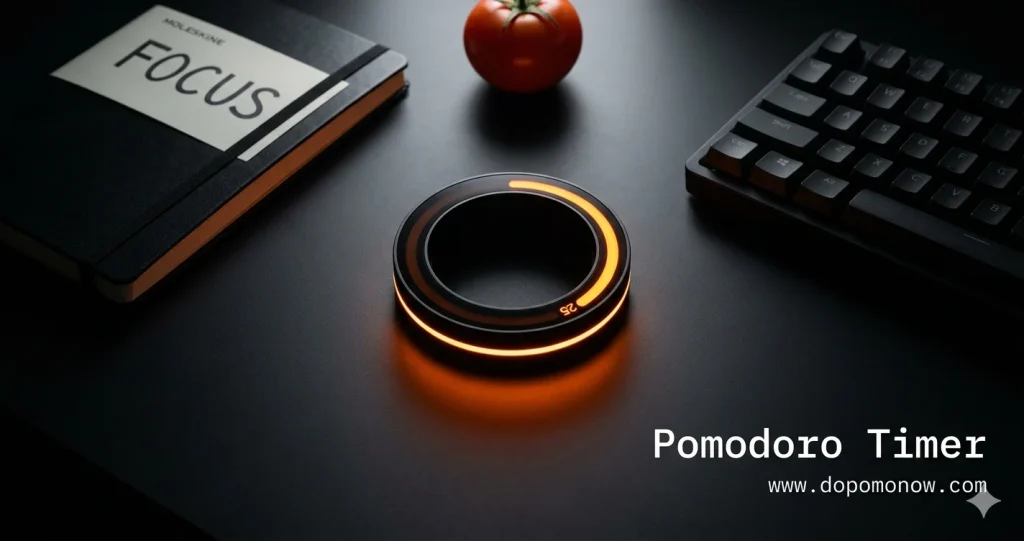
Pomodoro Timer: The Free Online Tool That Stops Procrastination for Good
A Pomodoro timer structures work into 25-minute focused sessions followed by 5-minute breaks. Based on Francesco Cirillo’s method, it is proven to reduce cognitive fatigue by 27%. DoPomoNow is free — no signup, works on all devices.
In this guide, you will learn exactly what a Pomodoro timer is, why the science behind it is solid, how to use one effectively, and which timer intervals work best for your specific type of work.
A Pomodoro timer is a time management tool based on the Pomodoro Technique, developed by Francesco Cirillo in the late 1980s. It breaks work into focused 25-minute intervals called “Pomodoros,” each followed by a 5-minute break. After four Pomodoros, a longer 15–30 minute break is taken. The name comes from the Italian word for tomato. A 2025 meta-analysis of 5,270 participants confirmed the technique reduces cognitive fatigue by up to 27%. DoPomoNow is a free Pomodoro timer with lofi music, task tracking, and 6 languages — no account required.
Why the Pomodoro Timer Works — The Science
The Pomodoro timer is not a productivity hack. It is a tool built on three well-established principles of cognitive neuroscience that have been validated across thousands of participants in peer-reviewed research.
“Time-structured Pomodoro interventions consistently improved focus, reduced mental fatigue, and enhanced sustained task performance, outperforming self-paced breaks.” — 2025 Meta-Analysis, BMC Medical Education (5,270 participants, 32 studies)
Your brain’s capacity for sustained attention is finite and time-bound. Research shows focused attention operates in natural cycles of 20–50 minutes. A Pomodoro timer works with these biological rhythms instead of fighting them, producing more output with less exhaustion.
How to Use a Pomodoro Timer: Step-by-Step
Open DoPomoNow’s task manager. Write one concrete task — “Draft the project brief” not “work on project.” Specificity removes starting friction.
One task. No phone. No new tabs. Work until the timer rings. If a distraction arises, write it down and return after.
Stand up, stretch, drink water. The break is the method — never skip it. Do not check your phone.
That is one full Pomodoro cycle. Walk, eat, breathe. Then begin the next cycle. DoPomoNow tracks your dots.
Pomodoro Timer Intervals — Which Length Is Right for You?
The classic Pomodoro timer is set to 25 minutes, but research supports customizing the interval based on your task type and cognitive profile. DoPomoNow supports any custom interval from 1 to 120 minutes.
Building the habit, ADHD, or highly distracted days.
Best default. Email, writing, reading, general tasks.
Coding, architecture, research, data analysis.
Creative work where interruptions are expensive.
Best Free Pomodoro Timers Online — How DoPomoNow Compares
| Feature | DoPomoNow | Pomofocus | Tomato Timer |
|---|---|---|---|
| Background music | ✓ | ✗ | ✗ |
| Task manager | ✓ | Account needed | ✗ |
| No signup required | ✓ | ✗ | ✓ |
| 6 languages + Arabic RTL | ✓ | ✗ | ✗ |
| PWA — works offline | ✓ | ✗ | ✗ |
Who Should Use a Free Pomodoro Timer?
A free Pomodoro timer online is not only for students. Millions of professionals worldwide use the Pomodoro method to protect their most valuable cognitive hours. Here is who benefits most:
Break revision into 25-minute blocks. Retain more, cram less. Active recall on breaks boosts memory by up to 40%.
50/10 intervals protect deep coding flow. Fewer context switches. Better code quality per session.
Replaces the natural office rhythm with structured work-break boundaries at home.
External timer provides executive function scaffolding. Start at 15-minute intervals and build gradually.
25-minute commitment breaks writer’s block. Time pressure creates productive urgency.
Every Pomodoro = 25 min billable focus. Natural time-tracking unit for client work.
Pomodoro Timer with Music — Does It Actually Help?
Research on music and focus is more nuanced than popular opinion suggests. Music with lyrics impairs verbal tasks — reading comprehension and essay writing suffer when lyrics compete for the same cognitive channel. However, low-stimulation instrumental audio — lofi hip-hop, brown noise, rain sounds — reduces environmental distraction without adding cognitive load.
A 2024 study from Northeastern University published in Communications Biology found that specifically modulated ambient audio produced greater activation in attentional brain networks. DoPomoNow’s six playlists are curated precisely for Pomodoro-length sessions. Choose brown noise for ADHD or maths; lofi hip-hop for writing and general study; solo piano for coding sessions.
For more on the Pomodoro Technique and its scientific backing, see the comprehensive research overview at Wikipedia’s Pomodoro Technique page.
Also explore our related guides on study timer techniques and deep work focus timers.
Free Pomodoro timer — lofi music, task tracking, no signup.
Open DoPomoNow →